
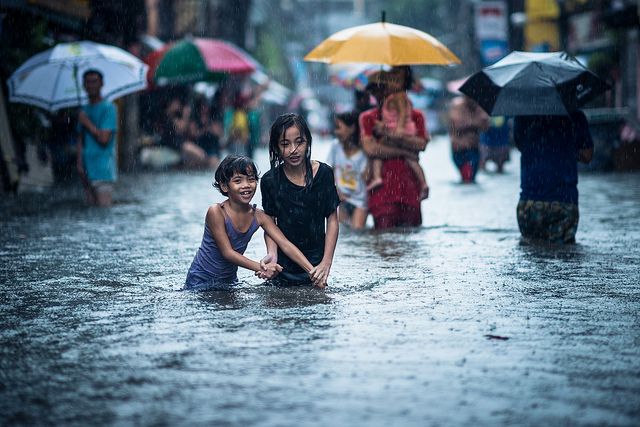
Flooding has been the most common and expected problem whenever typhoons and strong rains happen. The Philippines has been dealing with this problem for a long time, especially in big cities. The government already made plans for this before, but when flood control projects were introduced, more problems started to appear.
But just because the government can’t fully fix it doesn’t mean we can’t do anything. Flooding mostly happens because of littering, especially from people who don’t know how to properly segregate their trash and just throw it anywhere. This is a YOU problem, but sadly, many Filipinos still haven’t learned this yet. That is why this is what we aim to address and make people more aware of.
We are Grade 11 HUMSS students from La Salle Academy of Iligan City, committed to becoming socially responsible individuals who are aware of the issues affecting our community. As HUMSS students, we focus on understanding people, society, and social problems. Through a community-based approach, we aim to observe real-life issues, analyze their causes, and take action in ways that promote positive change, especially within our local community.

The Disciplined Hand represents the idea that change starts with our own actions. The hand symbolizes individual effort, responsibility, and control over one’s behavior. When guided by discipline, the hand becomes a tool for positive action—such as properly throwing trash, segregating waste, and caring for the environment. This symbol reminds us that preventing flooding and protecting our community does not rely solely on the government, but on each person’s willingness to act responsibly.
Improper waste disposal is one of the primary causes of water pollution in many communities. When trash is dumped into maintained areas such as canals, drainage systems, or rivers, it is carried into protected water sources. This leads to the mixing of plastics, food waste, and chemicals with the water, ultimately reducing water quality.
Improperly managed waste affects water quality in several ways:
Water becomes contaminated when harmful substances are introduced into it. These contaminants may include:
Drought occurs when there is insufficient clean and accessible water. Several factors contribute to this condition:
Flooding becomes more severe when waste obstructs the movement of water. This can happen when:
Many communities are increasingly experiencing water-related challenges, such as:
Limited access to clean water as contamination spreads through local water sources
| Indicator | Description | Observed Data | Analysis / Interpretation |
|---|---|---|---|
| Frequency of Flooding | How often flooding occurs during heavy rains | Frequent flooding in low-lying areas | Shows weak flood prevention and drainage maintenance |
| Waste Disposal Behavior | Community trash disposal practices | Improper waste segregation observed | Leads to clogged drainage systems |
| Drainage Condition | State of canals and drainage systems | Drains blocked with plastic waste | Direct contributor to flooding |
| Public Awareness | Understanding of flooding causes | Limited awareness in some residents | Lack of knowledge affects discipline |
| Community Participation | Involvement in clean-up activities | Low to moderate participation | Stronger participation can help reduce flooding |

Participate in community cleanup drives.
Community members play a crucial role in maintaining a clean and safe environment. When you observe waste-related or water-related concerns, report them promptly so that appropriate interventions can be carried out.
In the roads of our city lies a rubbishy race.
We ponder and see value in our resources to trace,
Which things seem important to compensate—
This garbage lies in many of our states.
To see trash is to see importance.
To face waste is to control a garbage haste.
Demolish what must be polished, for
Our city’s garbage can still be garnished.
Reuse the garbage you can reduce,
For it helps control what’s loose.
A better world ahead awaits a brighter tomorrow.
The voice of our city brings no sorrow.
The garbage sets sail and on the water it rows;
People can resolve what the animals crow.
Together, our city will grow.
If we allow our cities to demolish garbage we throw,
We create space for our waters to flow.
To polish our garbage allows our city to glow.
This is the right time to start the blow
And follow the idea of CLAYGO.
See our cities and their resources.
The rivers flow gracefully, without force.
But the garbage scattered in our city shows a horrible discourse.
Together, we can make a change—
For our city, places, and homes to be restored.